
By LoiterGuard Team on November 20, 2025
Learn how buildings deter loitering without cameras or constant patrols. Explore privacy-first, non-confrontational alternatives to guards and surveillance.
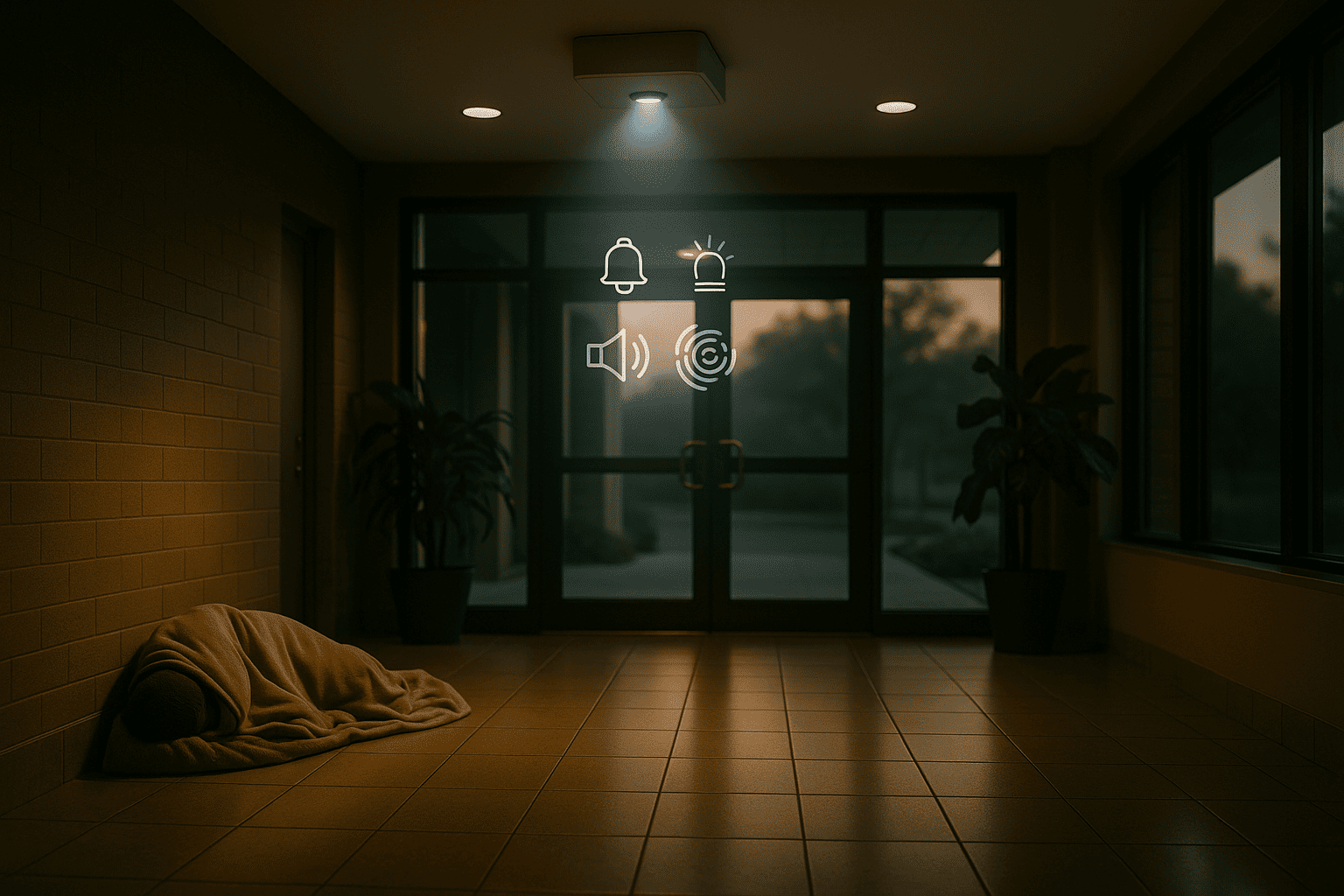
Loitering in shared building spaces is a common challenge for property managers, security teams, and building operators. Entrances, vestibules, stairwells, and corridors are often where issues arise - particularly during overnight or early-morning hours.
Traditionally, organizations have been forced into a difficult tradeoff: expand camera coverage into sensitive areas, or increase reliance on physical security patrols. Both approaches come with significant drawbacks.
Increasingly, operators are looking for ways to deter loitering without cameras or guards - solutions that reduce escalation, preserve privacy, and control costs.
Security cameras are often the default response to loitering concerns. However, cameras introduce challenges that are easy to underestimate:
In many cases, cameras capture activity without preventing it. Intervention still requires human response - often after issues have already escalated.
Security patrols can be effective, but as many organizations discover, security patrols don’t scale cleanly:
For many buildings, constant patrols are neither cost-effective nor sustainable.
Deterrence does not require observation or confrontation.
A preventive approach focuses on:
This model reduces reliance on cameras and guards while still improving outcomes.
Deterrence without surveillance is particularly effective in:
These are areas where cameras are often restricted or ineffective, yet issues commonly occur. This includes challenging environments like stairwells, which require special consideration.
Deterring loitering without cameras or guards is not about removing people or increasing enforcement. It’s about shifting from surveillance to de-escalation and designing environments that discourage prolonged lingering while maintaining dignity.
As buildings become more complex - and privacy expectations continue to rise - preventive, camera-free deterrence will play an increasingly important role in shared space safety.
Security patrols are expensive and inefficient at scale. Learn why patrol-only models fail - and how targeted response reduces cost and escalation.
Discover how buildings manage loitering in washrooms, stairwells, and other camera-restricted spaces using privacy-first deterrence.
Have a question or want to discuss how LoiterGuard can fit into your security strategy? Get in touch with our team.
Contact Us